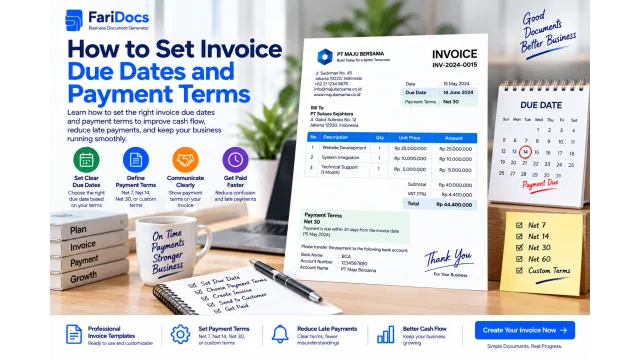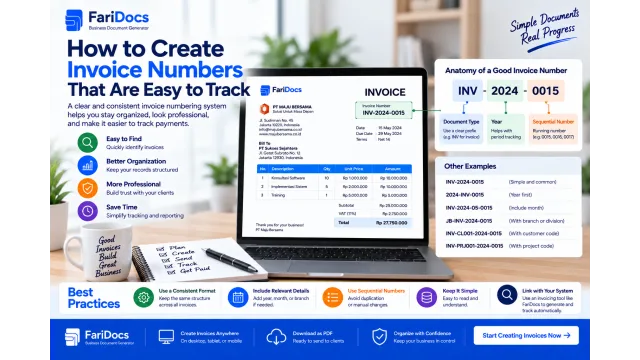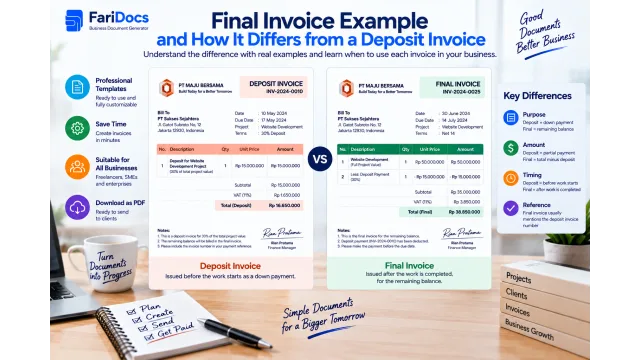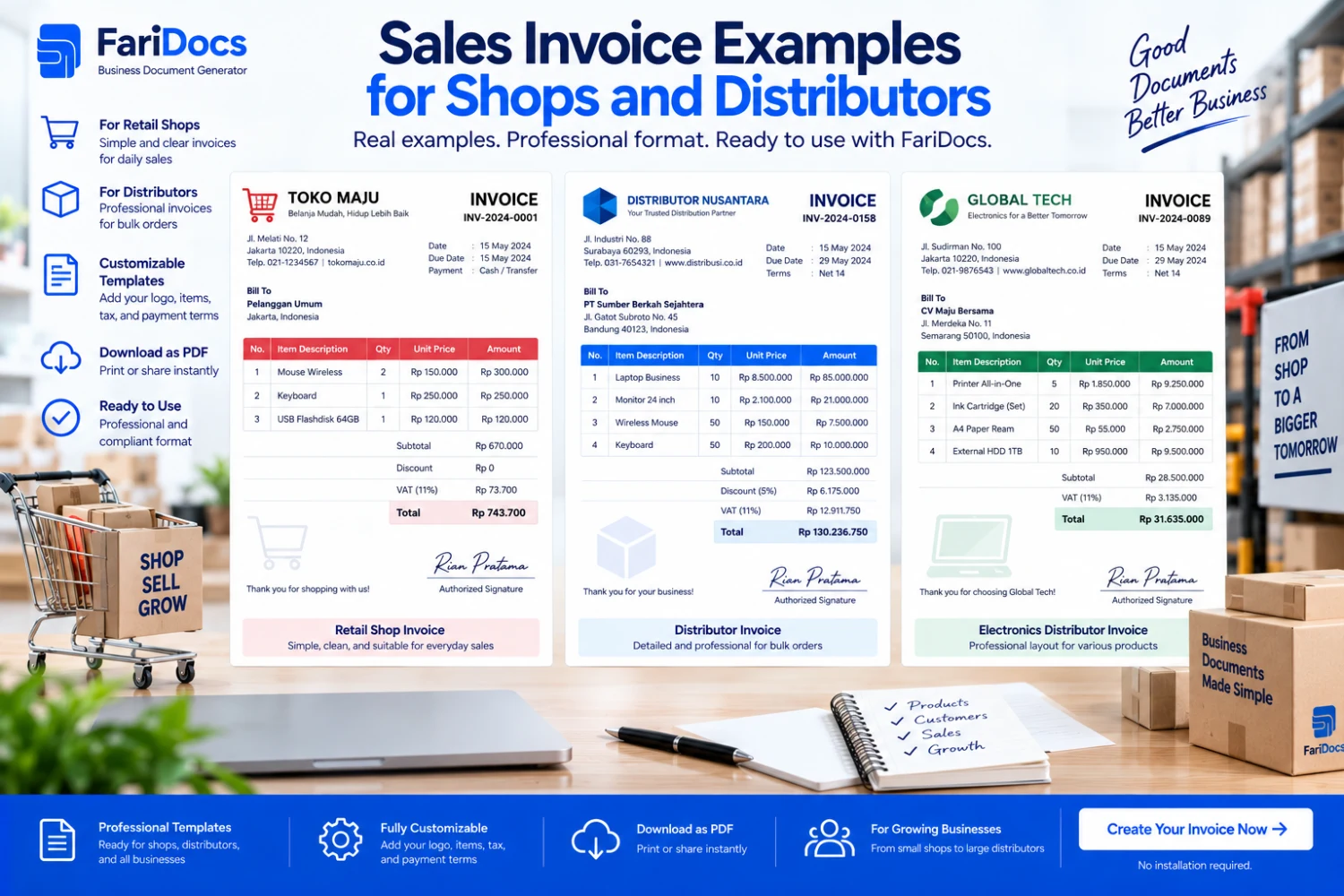
A clear sales invoice includes the seller and buyer, an invoice number, dates, product details, quantities, units, prices, the total due, and payment instructions. For distributors, add order references, pack sizes, and delivery details so customers can match the bill to their purchase.
Details such as “price per carton” and “price per item” can make a substantial difference to the amount billed. Explicit units help shop staff, warehouse teams, and finance departments check a transaction without asking how the price was calculated.
This guide includes retail and wholesale invoice examples, calculation steps, and a practical guide to creating a PDF with FariDocs.
What Is a Sales Invoice for Goods?
A sales invoice is a document issued by a seller to detail charges for products sold to a customer. It identifies the goods being billed, their quantities and prices, and the agreed payment terms.
Invoices can be used for immediate payments and sales on credit. Issue timing follows the agreement: for example, before delivery when payment is required in advance, or after delivery when billing is based on goods shipped.
An invoice does not automatically establish that goods have arrived or payment has been received. Delivery references and payment records help clarify those separate events.
What to Include in a Sales Invoice
SectionInformation to prepareSellerShop or company name, address, and contact detailsCustomerBuyer or company name and billing addressInvoice detailsUnique invoice number and issue dateTransaction referencesPurchase order or order number, plus a relevant delivery note referenceGoodsProduct code if available, name, specifications or variant, quantity, unit, priceChargesSubtotal, discounts, delivery fees, and applicable adjustmentsPaymentTotal, payments received, balance due, deadline, and bank detailsDeliveryRecipient and delivery address if different from the billing addressNotesAgreed terms and a contact for billing questionsUse sufficiently specific product descriptions. “A4 paper, 80 gsm, 500 sheets per ream” is easier to check than “paper”, particularly when a customer orders multiple sizes or brands.
Retail Sales Invoice Example
This fictional example shows a stationery shop billing a company. All prices in this article are illustrative, rather than market price guidance. The examples exclude taxes.
SALES INVOICE
FieldExampleSellerToko ATK ContohSeller address and contact[Shop address], [email or phone]Bill toPT Pelanggan ContohBilling address[Customer company address]Ship to[Recipient and delivery address]Invoice numberINV-TOKO-2026-0102Issue date12 September 2026Due date19 September 2026Order referencePO-ATK-0092ProductQuantityUnitPrice per unitAmountA4 paper, 80 gsm, 500 sheets per ream10ReamIDR 60,000IDR 600,000Black pens, 12 pieces per box5BoxIDR 36,000IDR 180,000A4 document folder20PieceIDR 5,000IDR 100,000Goods subtotalIDR 880,000Agreed discount−IDR 30,000Agreed delivery feeIDR 25,000Invoice totalIDR 875,000Payment receivedIDR 0Balance dueIDR 875,000Payment: [Bank name], [account number], account holder [name]. Include INV-TOKO-2026-0102 as the transfer reference.
Notes: Items and prices follow order PO-ATK-0092. Contact [billing contact] if any details differ from your records.
Replace every bracketed field before using the example. Check document numbers, addresses, quantities, and prices against the actual transaction.
Distributor Invoice Example with Wholesale Pricing
Wholesale customers may order by box or carton. State the pack size and price basis clearly to prevent double multiplication of unit quantities.
DISTRIBUTOR INVOICE
FieldExampleSellerDistributor Perlengkapan ContohSeller address and contact[Distributor address], [email or phone]Bill toToko Mitra ContohBilling address[Customer shop address]Ship to[Destination warehouse and recipient]Invoice numberINV-DST-2026-0215Issue date12 September 2026Payment terms14 calendar days from the invoice dateDue date26 September 2026PO referencePO-MITRA-0088Delivery note referenceSJ-2026-0312Product and pack sizeQuantityUnitPrice per unitAmountModel A drinking bottle, 24 pieces per carton10CartonIDR 480,000IDR 4,800,000Model B lunch box, 12 pieces per carton5CartonIDR 360,000IDR 1,800,000Goods subtotalIDR 6,600,000Wholesale discount: 5% of goods subtotal−IDR 330,000Agreed delivery feeIDR 150,000Invoice totalIDR 6,420,000Deposit received−IDR 2,000,000Balance dueIDR 4,420,000Payment: [Bank name], [account number], account holder [name]. Use INV-DST-2026-0215 as the payment reference.
Notes: Prices are per carton. The discount applies to the goods subtotal before delivery. The IDR 2,000,000 deposit was received and verified on 10 September 2026.
This example bills 10 cartons of bottles and five cartons of lunch boxes. The pack sizes identify the physical quantities: 240 bottles and 60 lunch boxes. Because the prices are already per carton, do not multiply the carton price by the pack size again.
How to Calculate the Invoice Total
For the examples above, which exclude taxes, use this sequence:
Line amount = quantity × price for the stated unit.
Subtotal = sum of all product line amounts.
Invoice total = subtotal − discount + agreed delivery charges.
Balance due = invoice total − payments received.
In the distributor example, IDR 6,600,000 less the IDR 330,000 discount plus IDR 150,000 delivery gives IDR 6,420,000. Deducting the IDR 2,000,000 deposit leaves IDR 4,420,000 payable.
State what a percentage discount applies to: all goods, selected products, or a particular charge. Avoid accidentally applying another discount when the unit prices already reflect the agreed reduction.
Keep deposits separate from discounts. A discount reduces the transaction price, whereas a deposit is a payment toward the transaction.
Retail and Distributor Invoice Needs Compared
RequirementShopDistributorSales unitsMay use individual items, sets, or small packsOften includes boxes, cartons, or wholesale unitsProduct descriptionsNames, sizes, variants, and quantitiesProduct codes, pack sizes, and price units need particular clarityPricingFollows the customer transactionMay follow wholesale lists or customer agreementsDeliveryCollection or customer deliveryMay involve warehouse destinations and multiple shipmentsReferencesOrder numbers help retrievalPOs and delivery notes help reconcile billingThese are common administrative patterns, not restrictions. Shops can handle large orders and distributors can sell individual items. Adapt the invoice to the actual transaction.
What If Goods Are Delivered in Parts?
Check the agreed billing basis before invoicing. If a customer orders 100 units but only 60 have been shipped, the invoice quantity depends on whether billing follows shipments or requires advance payment for the order.
For shipment-based billing, 60 units at IDR 100,000 each produce a bill of IDR 6,000,000 before other adjustments. Reference the delivery note covering those 60 units and track the remaining 40 units as not yet billed.
If the agreement requires advance payment for the whole order, explain that basis on the invoice. Do not describe all 100 units as shipped when only 60 have been dispatched.
How Invoices Relate to POs, Delivery Notes, and Receipts
A PO records the buyer's order. A delivery note identifies goods in a particular shipment. An invoice details the agreed charges. A payment receipt acknowledges money received.
Use consistent references to connect them. For example, invoice INV-DST-2026-0215 can reference PO-MITRA-0088 and delivery note SJ-2026-0312. Payment records then refer to that invoice number.
Delivery and payment documents should not be treated as new sales simply because they are separate documents. They can all relate to the same underlying transaction.
How to Create a Sales Invoice with FariDocs
The FariDocs invoice generator provides product, quantity, price, discount, delivery, and payment fields, with preview and PDF download. Use the order details and verified payment records when completing the document.
1. Enter Identities and References
Add the seller, customer, invoice number, issue date, and due date. Distinguish the billing address from the delivery destination if the goods are going to a separate warehouse.
2. Add Product Details
Use separate lines for products or variants with different prices. If you are not using a separate unit column, include the unit in the description, such as “Model A bottle — per carton, 24 pieces”. Enter a quantity of 10 and a price of IDR 480,000 to follow the distributor example.
3. Complete the Charges
Add agreed discounts and delivery charges. Record only payments actually received. Match the total and remaining balance against your transaction calculation.
4. Add Payment Instructions
Include the bank account, account holder, and reference the customer should use. Add notes about units or the billing basis where useful.
5. Review and Download the PDF
Review the preview, download the PDF, and open the file. Check that long descriptions, amounts, and bank details remain readable. Send it to the customer's billing contact and retain a copy named, for example, INV-DST-2026-0215-Toko-Mitra.pdf.
Common Mistakes to Avoid
Combining quantities in pieces with carton prices without conversion.
Grouping different variants so the customer cannot check each item.
Adding delivery fees twice when they are already included in the price.
Applying a discount again to already discounted prices.
Billing goods that appeared on an earlier invoice a second time.
Changing a bill after a return without explaining or referencing the adjustment.
Marking an invoice paid before incoming funds have been verified.
When goods are returned, confirm the approved products and quantities. Document the adjustment against the original invoice so the change can be traced.
Frequently Asked Questions
Should a small shop issue invoices?
Invoices are useful when customers need formal billing details, buy on credit, or require documents for their finance team. The need depends on the transaction and customer requirements, rather than shop size alone.
What is the difference between an invoice and a delivery note?
An invoice focuses on billing, while a delivery note focuses on goods shipped. Cross-references help match delivery quantities with the bill.
How should I show a price per box or carton?
State the price unit and pack size, such as “IDR 480,000 per carton, 24 pieces per carton”. Calculate using carton quantities when the entered price is per carton.
Can delivery charges appear on the invoice?
Include delivery charges that are billed under the agreement. Show them separately so the customer can distinguish the value of the goods from transportation costs.
What if the customer pays only part of the invoice?
Show the invoice total, verified payments received, and outstanding balance. Do not describe a partial payment as full settlement.
Does creating an invoice automatically update inventory?
Creating an invoice document does not itself establish that inventory has been updated. Record outgoing stock in your inventory system and reconcile it with deliveries and invoices.
Prepare a clear sales invoice with FariDocs. Add precise product descriptions, check that quantities and price units match, and download a PDF for your customer.