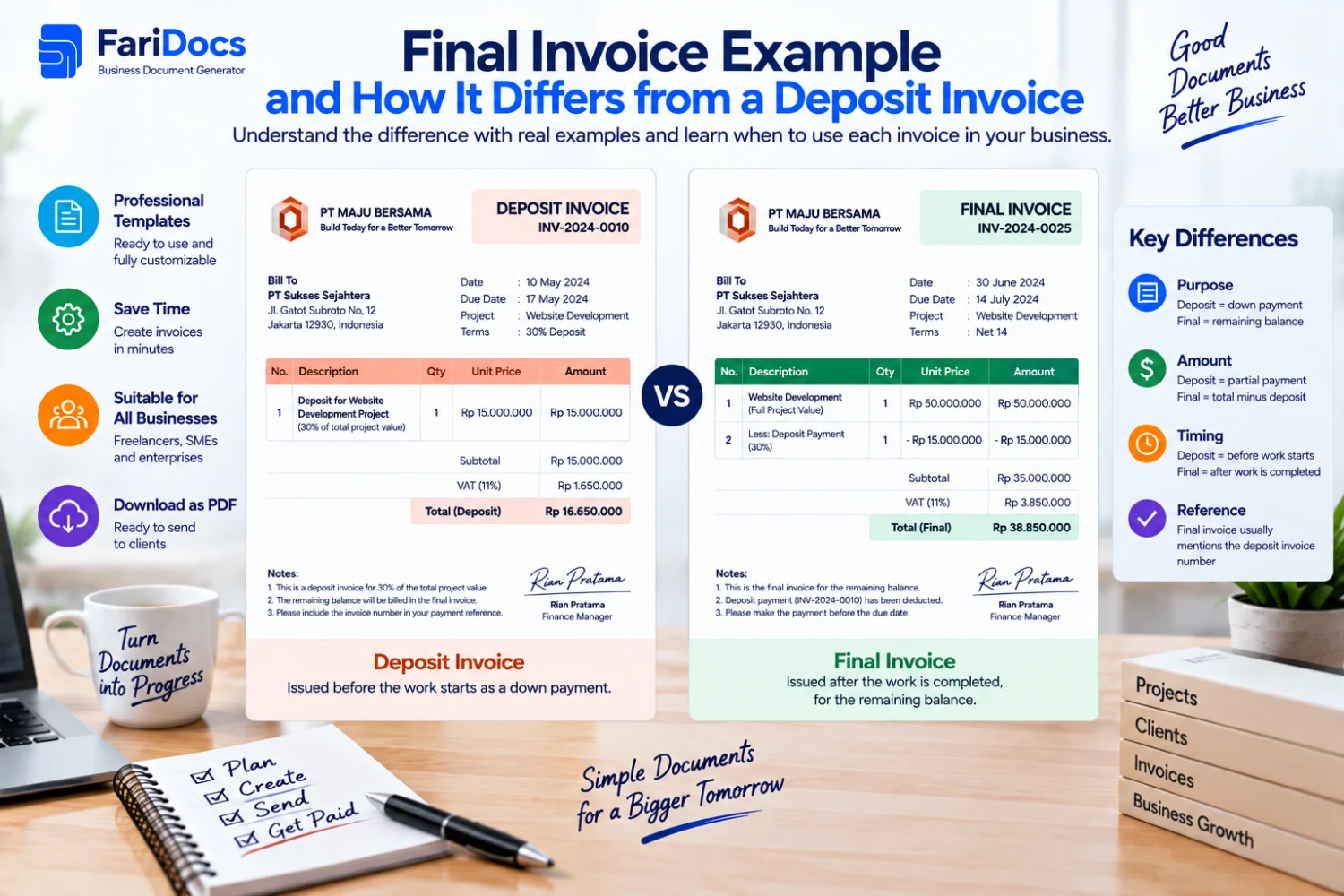
A final invoice requests the remaining payment for a transaction after accounting for deposits or earlier payments. A deposit invoice requests an advance payment, while a final invoice requests the outstanding balance under the agreement.
For example, an order worth IDR 10,000,000 with a verified deposit of IDR 3,000,000 leaves IDR 7,000,000 payable. The final invoice should make that balance clear so the customer does not pay the deposit again.
A final invoice is a request to settle the balance, not evidence that the transaction is already paid. Record paid status only after verifying the required payment.
What Is a Final Invoice?
A final invoice bills the remaining payment for an order, service, or project. It typically relates to a deposit invoice, milestone invoices, or earlier payments.
Examples include custom product orders, design services, website development, equipment installation, and project work.
Its timing follows the agreement. Final payment may be required before dispatch, after delivery, or following approval of completed work. A final invoice does not necessarily have to wait until delivery or completion.
Final Invoice vs Deposit Invoice
AspectDeposit invoiceFinal invoicePurposeRequests an advance paymentRequests the remaining paymentTimingAt the agreed initial payment stageWhen the final billing condition is metCalculation basisAgreed percentage or fixed depositAgreed transaction value after adjustments and previous paymentsKey detailsDeposit basis, order value, current requestOrder reference, earlier payments, outstanding balanceIDR 10,000,000 example30% deposit of IDR 3,000,000IDR 7,000,000 after receipt of the depositAfter paymentThe deposit obligation is settledThe billed balance is settled; check for any other obligationsUse the same transaction reference to connect both documents. For separate bills, use different invoice numbers so the customer can distinguish the deposit from the final payment request.
What to Include in a Final Invoice
Prepare:
The issuer's name, address, and contact details.
The customer name and billing address.
Invoice number, issue date, and due date.
PO, contract, quotation, or project reference.
Goods or services underlying the bill.
Previous payments and their references.
The amount currently payable.
Bank details, account holder, and payment instructions.
Include relevant supporting documents requested by the customer, such as a delivery note, work approval, or handover record.
Final Invoice Example after a 30% Deposit
This fictional example covers an office supplies order worth IDR 10,000,000. A deposit of IDR 3,000,000 has been received. The invoice bills only the remaining 70% and excludes taxes, retention, and additional charges.
FINAL INVOICE
Issuer: PT Penjual Contoh
Address: [Company address]
Contact: [Email and phone number]
Previous payment note: A 30% deposit of IDR 3,000,000 was received and verified on 10 September 2026 under invoice INV-DP-2026-0042. The IDR 7,000,000 billed here is already the balance after that deposit.
Payment instructions: [Bank name], [account number], account holder [name]. Include INV-FINAL-2026-0042 as the transfer reference.
Example payment condition: Final payment is required before dispatch under the accepted order.
Replace all identities and bracketed fields before use. Adjust the dates and payment conditions to the actual agreement.
Two Ways to Present a Deposit on the Final Invoice
1. Bill Only the Remaining Balance
As in the example above, the invoice line is IDR 7,000,000. The IDR 10,000,000 order value and IDR 3,000,000 deposit appear as reference information.
Do not apply the old deposit as another payment against this new IDR 7,000,000 bill. Doing so would incorrectly reduce the balance to IDR 4,000,000.
2. Show the Full Value Less Previous Payments
Alternatively, use a cumulative summary:
ItemAmountTotal order valueIDR 10,000,000Deposit received−IDR 3,000,000Outstanding payment requestedIDR 7,000,000Here, the starting value is IDR 10,000,000, so deducting the deposit produces the correct balance.
Choose one approach and explain the calculation basis. Do not mix a balance-only bill with a second deposit deduction. When preparing transaction summaries, link the documents to the same order so a restated full value is not counted as a new sale.
Calculating the Final Balance after Multiple Payments
For a simple example without other adjustments:
Final balance = transaction value − total payments received for that transaction.
Suppose a project worth IDR 20,000,000 has received two payments:
ItemAmountProject valueIDR 20,000,000Deposit receivedIDR 6,000,000Second milestone payment receivedIDR 8,000,000Total payments receivedIDR 14,000,000Final balanceIDR 6,000,000Use verified payments rather than simply subtracting the amounts of earlier invoices. An issued invoice may still be unpaid.
If an earlier milestone remains unpaid, decide whether the final bill covers only the last stage or summarizes all outstanding amounts. Explain the references and treatment of earlier bills so the same amount is not requested twice.
How to Create a Final Invoice with FariDocs
The FariDocs invoice generator supports line items, transaction references, amounts paid, balance calculations, preview, and PDF download.
For the balance-only example:
Enter the issuer and customer details from the order.
Use a new final invoice number and reference the deposit invoice.
Describe the remaining payment and identify the PO or project.
Enter quantity 1 and a price of IDR 7,000,000.
Explain the full value and previous deposit in the notes without deducting it again.
Add the agreed due date and bank details.
Check the PDF before sending it to the customer's billing contact.
For a cumulative presentation, enter the full value and account for earlier payments once. Confirm that the result matches the correct remaining balance.
What Happens after the Customer Pays?
Match the incoming funds to the customer, amount, and invoice number. Record the payment date and reference, then update the balance.
If the customer pays IDR 5,000,000 against a final invoice of IDR 7,000,000, IDR 2,000,000 remains due. The title “final invoice” does not turn a partial payment into full settlement.
Send payment confirmation or a receipt when needed. For projects with retention, check whether an amount is still withheld and when it becomes payable before stating that all payment obligations are complete.
Sample Email for Sending a Final Invoice
Subject: Final Invoice — PO-2026-0087 — INV-FINAL-2026-0042
Dear [Customer Name],
Please find attached invoice INV-FINAL-2026-0042 for the remaining payment under order PO-2026-0087.
The order value is IDR 10,000,000. After accounting for the IDR 3,000,000 deposit received, the remaining payment is IDR 7,000,000, due on 24 September 2026.
As agreed, dispatch will take place after the final payment is received. Please include the invoice number as your payment reference.
Let us know if you need any additional billing information or supporting documents.
Thank you.
Best regards,
[Name and company]
Frequently Asked Questions
Is a final invoice the same as a paid invoice?
No. A final invoice requests the remaining payment. A paid invoice reflects a bill settled according to verified payment records.
Should the deposit appear on the final invoice?
Include its amount and reference so the customer understands the calculation. Deduct it when showing the full value, or describe it in the notes when billing only the balance.
Should the final invoice have a different number from the deposit invoice?
Use a different number for a separate bill and connect it through the order reference. If merely updating the balance on the same document, present it as an update rather than another bill.
What if the order changes or extra work is added?
Use approved changes. Explain the additions or reductions and recalculate the balance after accounting for earlier payments.
What if the payment received is less than the invoice amount?
Clarify the difference with the customer. Do not automatically mark the bill paid or treat every difference as overdue without checking the supporting records and payment terms.
Can a final invoice be used for services?
Yes. Identify the work, scope or period, agreement reference, and basis for requesting the remaining payment.
Create your final invoice with FariDocs. Reference the order and deposit invoice, verify earlier payments, and clearly show the amount the customer still needs to pay.