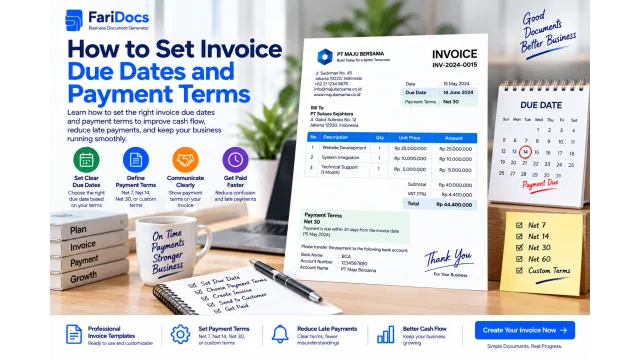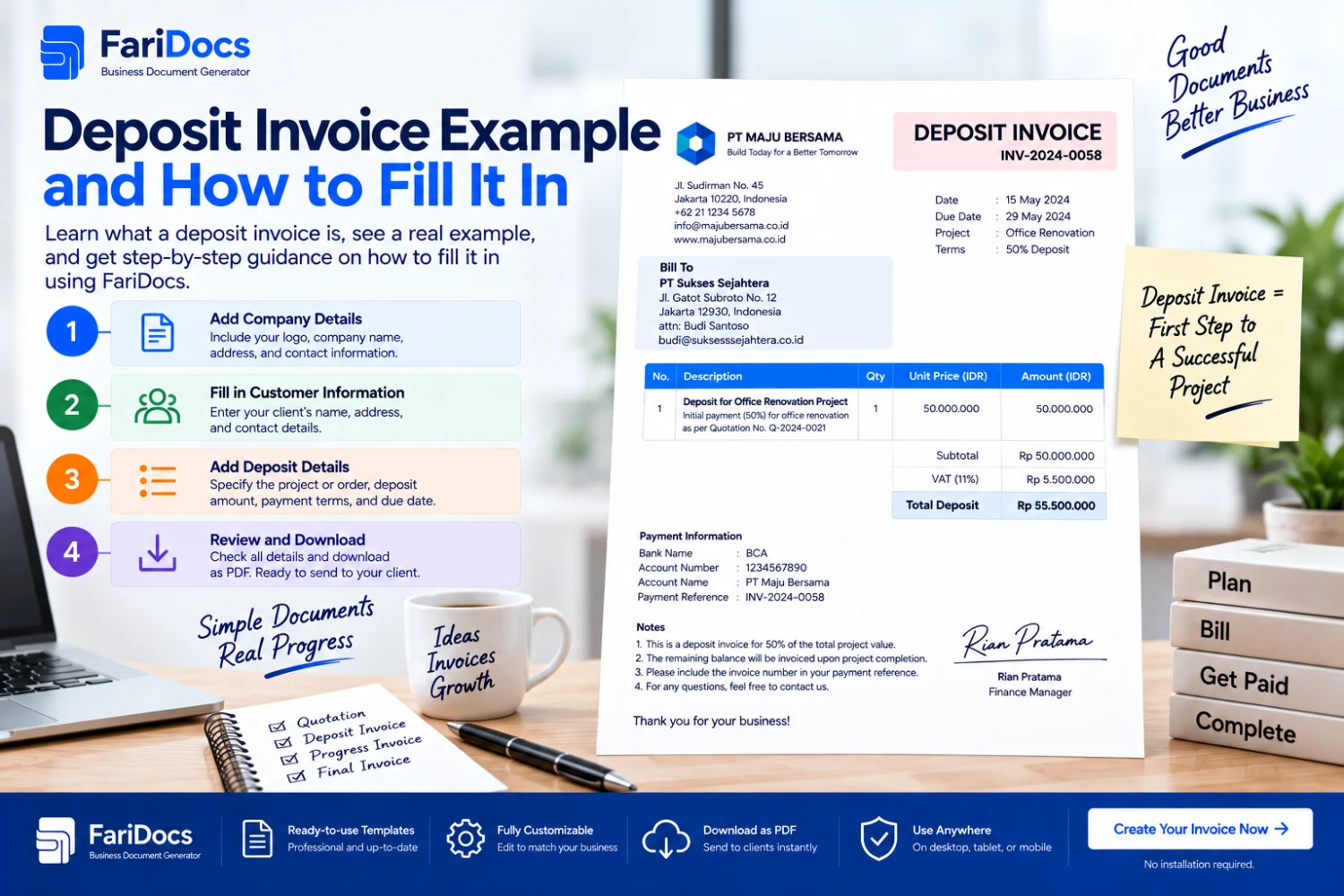
A deposit invoice requests an advance payment before a customer pays the full transaction amount. It identifies the seller and buyer, references the order, states the deposit amount and due date, and provides payment instructions.
Deposits, also called down payments, can be used for product orders, services, and projects paid in stages.
The key distinction is between a deposit being requested and a deposit already received. Confusing these can make an unpaid invoice appear settled.
What Is a Deposit Invoice?
A deposit invoice requests part of an order or project’s value under the agreed payment terms. The deposit may be a percentage of the transaction or a fixed amount.
Examples include:
- A 30% deposit for a product order.
- A 50% advance payment before design work begins.
- A fixed IDR 2,000,000 payment to reserve a service.
- An initial project payment before implementation.
The amount and timing depend on the agreement. There is no single deposit percentage suitable for every business.
A deposit invoice tells the customer what is payable now and how that payment relates to the full order.
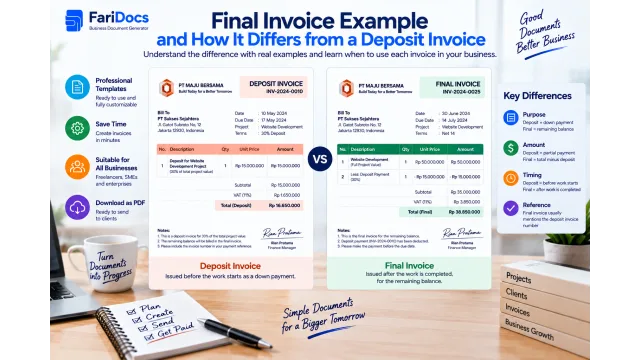
Deposit Invoice vs Receipt vs Final Invoice
DocumentPurposeAmount shownDeposit invoiceRequests an advance paymentThe agreed deposit currently payablePayment receiptAcknowledges money receivedThe amount actually receivedFinal invoiceRequests the remaining paymentThe balance after accounting for previous paymentsIssuing a deposit invoice does not establish that the funds have arrived. Verify incoming payments and match them to the correct invoice.
Do not mark a deposit invoice paid simply because it has been sent to the customer.
What to Include in a Deposit Invoice
SectionInformation to enterIssuerBusiness or service provider name, address, and contact detailsCustomerCustomer or company name and billing addressInvoice numberA unique reference for the deposit billDatesIssue date and payment deadlineTransaction referenceQuotation, PO, contract, or project referenceTransaction valueThe amount used as the deposit calculation basisDeposit detailsPercentage or fixed amount and payment purposeCurrent amount dueThe deposit requested on this invoicePayment instructionsBank details, account holder, and transfer referenceNotesAgreed conditions for subsequent paymentsConfirm the price and scope before billing if they have not yet been agreed. The customer should understand the basis of the deposit request.
Example: A 30% Deposit Invoice for Goods
This fictional example covers an office supplies order worth IDR 10,000,000, with a 30% deposit. Calculations exclude taxes, delivery fees, and other adjustments.
DEPOSIT INVOICE
Issued by:
PT Penjual Contoh
[Company address]
[Email and phone number]
Payment instructions:
Bank: [Bank name]
Account number: [Account number]
Account holder: [Recipient name]
Notes:
Include INV-DP-2026-0042 as the payment reference. The remaining order value of IDR 7,000,000 will be billed at the agreed stage. This invoice requests only the deposit.
Replace all identities and bracketed fields before using the example.
How to Calculate a Percentage or Fixed Deposit
1. Percentage Deposit
Use this formula:
Deposit = agreed percentage × agreed transaction basis.
In the example:
30% × IDR 10,000,000 = IDR 3,000,000.
After receiving that deposit, the remaining transaction balance is:
IDR 10,000,000 − IDR 3,000,000 = IDR 7,000,000.
Specify the calculation basis, especially when the quotation includes separate goods, services, delivery charges, or price adjustments.
2. Fixed Deposit
Suppose a photography service worth IDR 5,000,000 requires a fixed IDR 1,500,000 deposit.
ItemAmountService valueIDR 5,000,000Deposit requestedIDR 1,500,000Remaining balance after deposit paymentIDR 3,500,000Use the agreed amount. There is no need to express it as a percentage when the agreement specifies a fixed deposit.
How to Fill In a Deposit Invoice with FariDocs
The FariDocs invoice generator includes billing details, payments received, balance calculations, preview, and PDF download.
To create a separate deposit invoice, follow these steps.
1. Enter the Seller and Customer
Use names and addresses consistent with the transaction. For corporate customers, check the legal business name and billing address with the finance team.
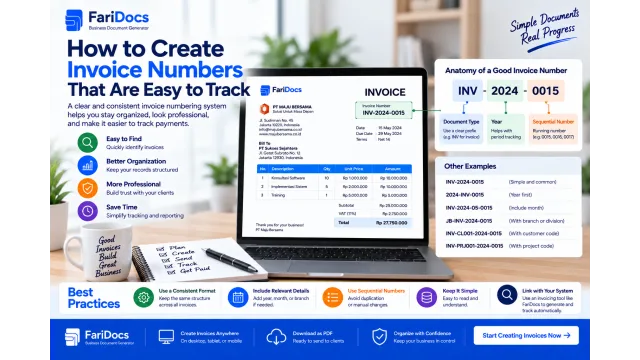
2. Set the Invoice Number and Dates
Use a unique number such as INV-DP-2026-0042. Enter the issue date and agreed payment deadline.
3. Add the Order Reference
Include the PO, contract, quotation, or project reference so the customer can identify the transaction.
4. Enter the Deposit as the Charge
For the IDR 3,000,000 example, enter:
- Description: 30% deposit under order PO-2026-0087.
- Quantity: 1.
- Price: IDR 3,000,000.
- Amount: IDR 3,000,000.
Explain the IDR 10,000,000 order value in the notes or description. Do not add it as another charge if the invoice requests only the deposit.
5. Check Payments Received
If the customer has not paid, leave the received payment at zero or omit the optional field.
Enter money as “paid” only after it has been received. Do not enter the requested deposit as a completed payment.
If the customer pays IDR 1,000,000 toward a deposit invoice of IDR 3,000,000, that invoice still has IDR 2,000,000 outstanding.
6. Add Payment Instructions and Review the PDF
Include the account details, recipient name, and invoice reference. Preview the document, download the PDF, and check it before sending.
Final Invoice Example after Receiving the Deposit
Once the IDR 3,000,000 deposit has been received and the final billing condition is met, the remaining payment can be presented in two ways.
Option A: Show the Full Transaction Less the Deposit
ItemAmountTotal order valueIDR 10,000,000Deposit received, reference INV-DP-2026-0042−IDR 3,000,000Balance dueIDR 7,000,000This presentation shows the full transaction and the earlier payment.
Option B: Bill Only the Remaining Amount
DescriptionAmountRemaining 70% payment under order PO-2026-0087IDR 7,000,000Final invoice totalIDR 7,000,000With Option B, explain the earlier deposit in the notes. Do not subtract it again from IDR 7,000,000, because that figure already represents the remaining balance.
Use a consistent approach. When recording sales, avoid treating the deposit invoice and a later restatement of the full order value as two separate sales.
Common Deposit Invoice Mistakes
Avoid:
- Recording a requested deposit as money received.
- Adding the full order value and deposit as separate charges.
- Deducting the deposit twice on the final invoice.
- Failing to identify the basis for a percentage deposit.
- Treating a paid deposit invoice as full settlement of the order.
- Reusing invoice numbers for unrelated transactions.
- Adding cancellation or deposit refund conditions that were never agreed.
A paid deposit invoice means the deposit obligation has been settled. The remaining order value still needs to be tracked under the payment schedule.
Sample Email for Sending a Deposit Invoice
Subject: 30% Deposit Invoice — Order PO-2026-0087
Dear [Customer Name],
Please find attached invoice INV-DP-2026-0042 for the 30% deposit under order PO-2026-0087.
The order value is IDR 10,000,000, making the requested deposit IDR 3,000,000. Payment is due on 21 September 2026.
The remaining IDR 7,000,000 will be billed at the agreed stage. Please include the invoice number as your payment reference.
Let us know if you need any additional billing information.
Thank you.
Best regards,
[Name and company]
Frequently Asked Questions
Is a deposit invoice the same as a receipt?
No. A deposit invoice requests advance payment. A receipt acknowledges money already received.
Must a deposit be a percentage?
No. It can be a percentage or a fixed amount, depending on the agreement.
What deposit percentage should a business use?
Consider the transaction, upfront costs, work schedule, and customer agreement. Examples such as 30% or 50% are not universal requirements.
Does paying the deposit invoice settle the entire order?
No. If the invoice requests only a deposit, paying it settles that deposit obligation.
What if the customer pays more than the deposit?
Verify the amount and confirm how it should be allocated. Record the additional payment against the appropriate transaction so it is not billed again at final settlement.
Can a proforma invoice request an advance payment?
Some business processes use a proforma invoice to communicate advance payment details. Confirm that the document type matches the agreement and the customer’s administrative needs.
Create your deposit invoice with FariDocs. State the calculation basis, current amount due, and order reference so the customer understands exactly what to pay.