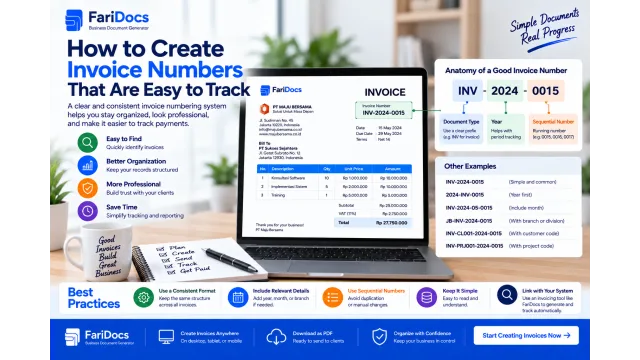
To set an invoice due date, agree on the starting event, the payment period, and whether it uses calendar or business days. Then state the resulting date clearly on the invoice. For installments, also define the amount and billing condition for each stage.
For example, an invoice dated 17 September 2026 is payable 14 calendar days after its issue date. Counting the issue date as day zero gives a due date of 1 October 2026.
Clear terms help customers schedule payments and help sellers plan follow-up. “Please pay promptly” provides less certainty than an agreed date.
Due Dates vs Payment Terms
A due date is the agreed payment deadline. Payment terms describe how and when payment takes place, including the payment period, deposit, method, or installments.
In Indonesian business usage, “termin” may refer either to a payment period or to staged payments. Explain the intended meaning rather than relying on the word alone.
TermPractical meaningExampleInvoice dateDate the document is issued17 September 2026Payment periodTime allowed from a defined starting point14 calendar days after the invoice dateDue datePayment deadline1 October 2026Installment scheduleDivision of the transaction into payments30% deposit, 40% second stage, 30% final paymentPayment methodHow the customer paysTransfer to the stated bank accountOne transaction can combine both: three milestone invoices, each payable within seven days.
What Do Net 7, Net 14, and Net 30 Mean?
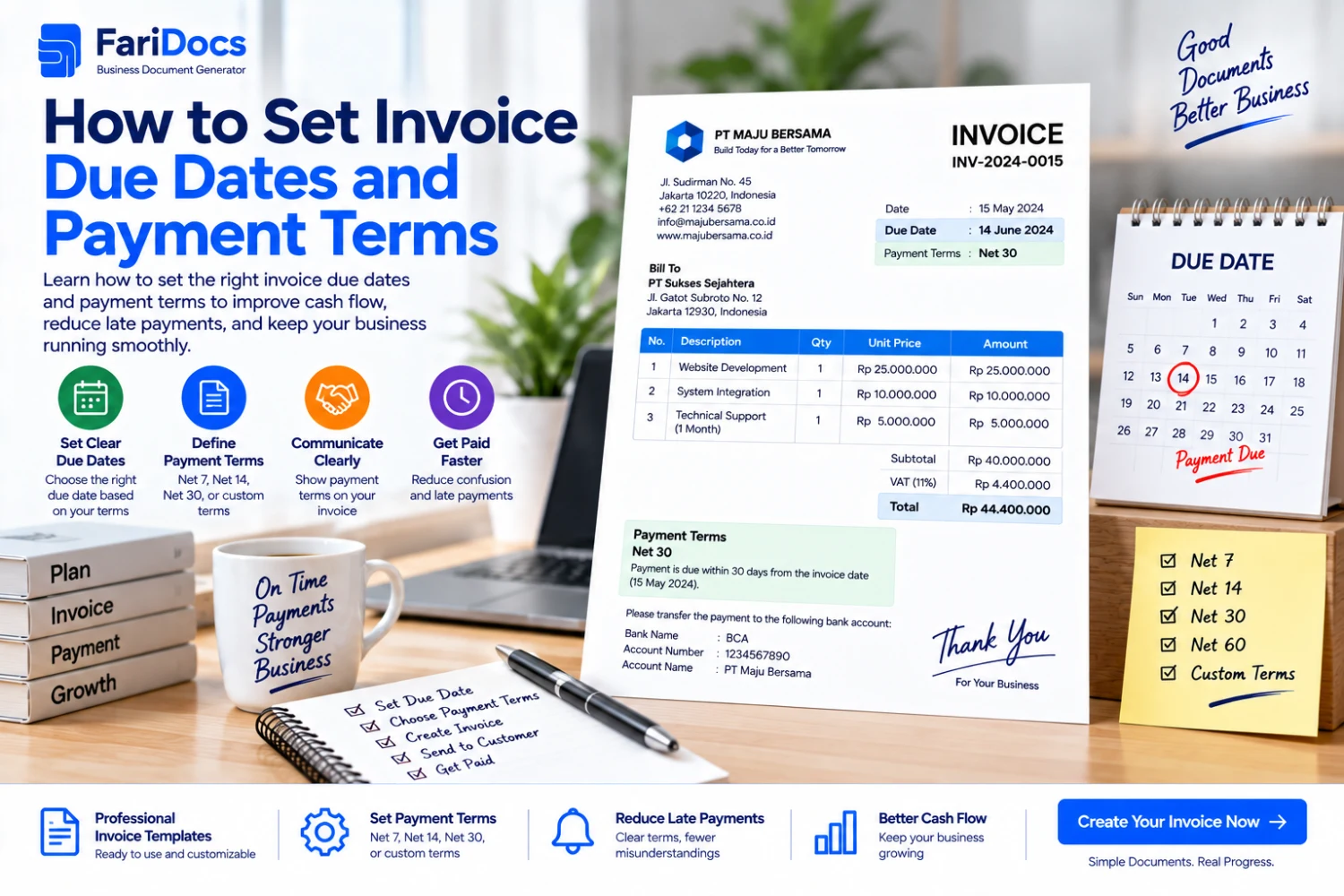
Net 7, Net 14, and Net 30 commonly describe full payment of the invoiced amount within 7, 14, or 30 days of the starting point defined in the agreement.
Do not rely on the abbreviation alone. Specify whether the period starts on the invoice date, receipt of the invoice, or receipt of complete supporting documents.
Example termClear explanationNet 7 from invoice datePayment within 7 calendar days after the invoice dateNet 14 from invoice datePayment within 14 calendar days after the invoice dateNet 30 from invoice datePayment within 30 calendar days after the invoice dateDue upon receiptPayment requested upon receipt of the invoice under the agreement50% deposit, balance before dispatchHalf paid upfront, with the remainder paid before shipmentNet 30 does not always mean the same date next month. Thirty days and one calendar month can produce different dates, so state the calculation basis.
How to Calculate an Invoice Due Date
For a calendar-day example:
Due date = agreed starting date + payment period in days.
The examples below treat the starting date as day zero and do not apply weekend or holiday adjustments.
Starting datePayment periodDue date17 September 20267 calendar days24 September 202617 September 202614 calendar days1 October 202617 September 202630 calendar days17 October 202631 January 202730 calendar days2 March 202717 October 2026 is a Saturday. If the agreement moves deadlines to the next business day, apply that rule and the relevant holiday calendar. Do not silently change the date or assume every company follows the same policy.
When the Period Starts upon Receipt
Suppose an invoice is issued on 17 September but received on 19 September 2026. If the agreement allows 14 calendar days after receipt, the due date is 3 October 2026 before any nonbusiness-day adjustment.
Retain confirmation of receipt. Sending and receiving dates may differ, especially when a customer uses a vendor portal or checks document completeness.
When Using Business Days
Define whether business days mean Monday through Friday, how holidays are handled, and whether the receipt day counts. Identify the applicable calendar for parties in different countries.
Do not calculate a 14-calendar-day term as 14 business days; the result can differ.
How to Choose Suitable Payment Terms
1. Identify Upfront Costs
If the transaction requires materials, custom goods, or initial work, consider an agreed deposit to cover part of those needs. Base its size on the transaction rather than copying a percentage without assessing the costs.
2. Understand the Customer's Payment Process
Ask whether payment requires a PO, work approval, supplier registration, or supporting documents. Understand payment processing dates before agreeing on the deadline.
If the customer processes payments only on certain dates, address this upfront rather than after an invoice becomes overdue.
3. Choose a Verifiable Starting Event
An invoice date is easy to check. Complete-document receipt needs evidence of completeness. Work approval needs a definition of the deliverable and the person responsible for acceptance.
If work approval triggers billing, also agree on the review period and how concerns will be raised. Avoid leaving the start of the payment period indefinitely uncertain.
4. Consider the Transaction History
New customers, custom orders, and repeat clients may need different arrangements. Consider how long the business can wait for payment and its prior experience with the customer, then agree on suitable terms openly.
5. Document the Agreement before Invoicing
Keep the quotation, PO or contract, and invoice consistent. If the accepted quotation says Net 30, do not unilaterally change it to Net 7 on the invoice.
Example Terms for Different Transactions
These are illustrative options to discuss with a customer, rather than universal requirements or recommendations.
TransactionExample arrangementWhat to clarifyCustom goods50% deposit, balance before dispatchWhen processing begins and goods are readyDesign services30% deposit, balance at the agreed final stageDeliverables, revisions, and file handover conditionsMonthly servicesPeriodic invoice, Net 14Billing at the beginning or end of the periodMilestone project30%–40%–30%, each invoice Net 7Stage conditions and approval evidenceCorporate saleA period agreed around the payment processPO, supporting documents, and finance contactExample Project Payment Schedule
A fictional IDR 20,000,000 project uses three installments. Each invoice is issued on the relevant milestone date and is payable seven calendar days after issue.
StageAmountInvoice dateDue date30% deposit before startingIDR 6,000,00017 September 202624 September 202640% after test version approvalIDR 8,000,0008 October 202615 October 202630% after approved handoverIDR 6,000,00029 October 20265 November 2026TotalIDR 20,000,000The second and final stage dates assume the billing conditions are met on those dates. If actual milestones change, apply the agreed rules to issuance and due dates rather than relying solely on the initial forecast.
Sample Invoice Payment Terms Wording
Payment from the Invoice Date
“Payment is due within 14 calendar days after the invoice date. For an invoice dated 17 September 2026, payment is due on 1 October 2026.”
Payment from Complete Document Receipt
“Payment is due within 30 calendar days after receipt of the invoice and complete supporting documents under the agreed document list. Receipt of the complete submission will be confirmed by email.”
Deposit and Final Payment
“A 50% deposit is payable before order processing begins. The remaining 50% is payable after notification that the goods are ready and before dispatch.”
Milestone Payments
“Payments comprise a 30% deposit, a 40% second installment, and a 30% final installment. Each stage's billing conditions follow the contract. Each invoice is payable within 7 calendar days after issue.”
Adapt the wording to the actual agreement. Also clarify whether the deadline refers to funds being received or a transfer being initiated, particularly for payment methods with settlement delays.
Entering Payment Terms and Due Dates in FariDocs
The document details section of the FariDocs invoice generator includes the invoice date, payment terms, and due date. Notes or payment conditions can provide additional explanation.
Prepare the starting date and calculation rule, then enter:
The invoice issue date.
Specific wording, such as “14 calendar days after the invoice date”.
The checked due date.
The PO or contract reference supporting those terms.
Billing details and payment instructions before reviewing the PDF.
Check that the written terms match the date. Do not assume that typing “Net 14” alone ensures a correctly calculated deadline.
What to Do When Payment Is Overdue
Check incoming funds, the outstanding balance, and any unresolved questions or missing documents. Then send a reminder identifying the invoice, balance, and due date.
Example:
“Hello [Name], we are following up on invoice [Number], with an outstanding balance of [Amount], due on [Date]. Our records show that payment has not yet been received. Could you please confirm the expected payment date or let us know if any documents are still required? Thank you.”
If a new schedule is agreed, retain the original date, revised date, and approval record. Avoid introducing new charges or conditions unilaterally in the reminder.
Frequently Asked Questions
Does Net 30 mean 30 business days?
Do not assume so. Specify calendar or business days in the agreement, along with the starting event.
Must every invoice allow 30 days for payment?
No. The period follows the transaction agreement and may differ by service, customer, and business needs.
Can a deposit and final payment have different due dates?
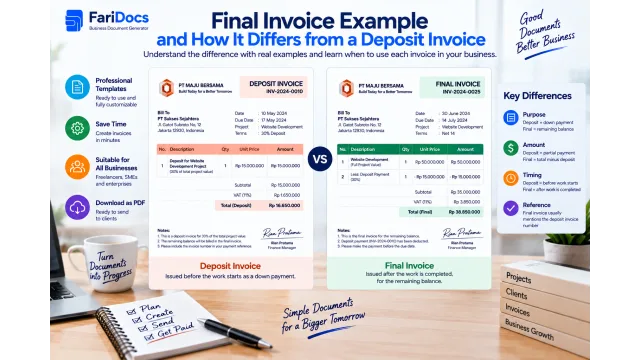
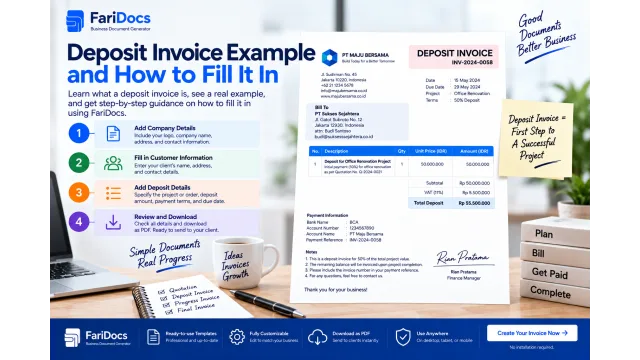
Yes. Each may have its own deadline or payment condition. State these clearly on the relevant bill.
What happens if the due date falls on a holiday?
Follow the agreed adjustment rule. If none exists, confirm the arrangement with the customer beforehand and record the outcome.
Does a partial payment change the due date?
A partial payment reduces the balance but does not automatically change the remaining payment deadline. Agree and document any schedule change.
Is the invoice date the same as the due date?
They serve different purposes. They can coincide when payment is agreed for the issue date, but check the transaction terms before treating them as identical.
Create your invoice with FariDocs using clear terms and checked dates. State the amount, timing basis, and transaction reference so customers can schedule payment accurately.