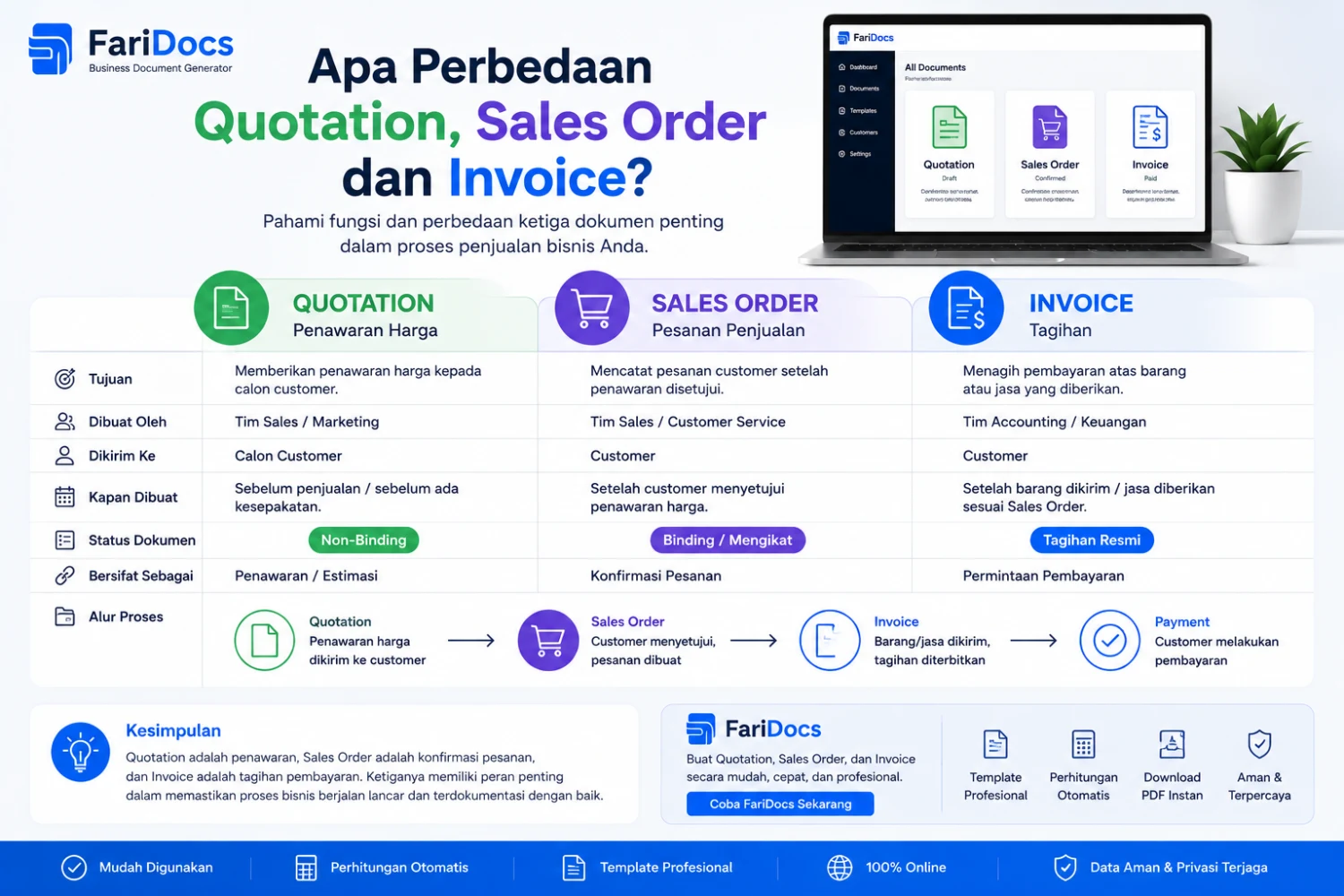
Businesses use several documents throughout the sales process, including Quotations, Sales Orders, and Invoices.
Although these documents are closely related, they have different purposes.
The simplest way to understand them is:
Quotation = Offer
Sales Order = Confirmed Order
Invoice = Billing
A typical sales workflow may look like:
Customer Request → Quotation → Customer Approval → Sales Order → Delivery → Invoice → Payment
Understanding the difference between these documents can help businesses improve sales operations, reduce administrative errors, and manage transactions more efficiently.
What Is a Quotation?
A Quotation is a document prepared by a seller to provide a customer with an offer for products or services.
It usually includes:
- Company information
- Customer information
- Quotation number
- Quotation date
- Products or services
- Quantity
- Unit price
- Discounts
- Taxes
- Total amount
- Payment terms
- Delivery terms
- Validity period
- Terms and Conditions
For example, a customer may request pricing for:
20 laptops
The sales representative creates a quotation:
20 × $1,000 = $20,000
The quotation is then sent to the customer for review and approval.
Main Purpose of a Quotation
A quotation is used to:
- Provide pricing.
- Describe products or services.
- Support negotiations.
- Support customer approval.
- Provide a basis for a Sales Order.
A quotation is generally not a billing document.
What Is a Sales Order?
A Sales Order (SO) is a document used by a seller to record and confirm a customer's order according to the company's sales workflow.
A Sales Order may be created based on:
- An accepted quotation
- A customer's Purchase Order
- A direct customer order
- Another approved sales agreement
It may contain:
- Sales Order number
- Customer
- Date
- Quotation reference
- Products or services
- Quantity
- Pricing
- Discount
- Tax
- Delivery date
- Shipping address
- Payment terms
- Sales representative
Main Purpose of a Sales Order
A Sales Order helps the company:
- Record customer orders.
- Manage fulfillment.
- Coordinate warehouse operations.
- Manage delivery.
- Support invoice creation.
- Track order status.
In simple terms:
A Sales Order tells the company what the customer ordered and what needs to be fulfilled.
What Is an Invoice?
An Invoice is a billing document issued by a seller to request payment from a customer for products or services according to the applicable transaction terms.
An invoice generally includes:
- Invoice number
- Customer
- Invoice date
- Due date
- Products or services
- Quantity
- Price
- Discount
- Tax
- Total amount
- Payment instructions
Example:
Invoice No.: INV-2026-00125
Total: $20,000
Due Date: September 30, 2026
The invoice is then sent to the customer according to the agreed billing process.
Quotation vs Sales Order vs Invoice
AspectQuotationSales OrderInvoiceMain purposeOfferConfirmed orderBillingCreated bySellerSellerSellerTimingBefore order confirmationAfter order confirmationDuring billingShowsWhat is offeredWhat is orderedWhat must be paidStatusOfferConfirmed orderBillingPaymentNot necessarily dueNot necessarily duePayment terms/due dateReferenceCustomer requestQuotation/POSales Order/delivery/transactionMain outputCustomer approvalFulfillmentPaymentQuotation vs Sales Order
The main difference between a quotation and a Sales Order is the transaction status.
Quotation
A quotation is an offer.
The seller is essentially saying:
"Here is what we can offer you."
The customer can still:
- Accept
- Reject
- Negotiate
- Change quantities
- Request different specifications
- Request discounts
Sales Order
A Sales Order records the confirmed order according to the company's workflow.
The seller is essentially saying:
"Here is the customer's order that needs to be processed."
Sales Order vs Invoice
A Sales Order focuses on the order and fulfillment process.
An Invoice focuses on billing and payment.
For example:
Customer orders:
10 laptops × $1,000 = $10,000
Sales Order:
Order Value = $10,000
After the applicable fulfillment or billing condition is met:
Invoice:
Amount Due = $10,000
Therefore:
Sales Order = What the customer ordered
Invoice = What the customer needs to pay
Quotation vs Invoice
A quotation is a commercial offer.
An invoice is a billing document.
Quotation
10 laptops
Unit Price: $1,000
Total Offer: $10,000
Validity: 30 days
After customer approval:
Invoice
Invoice No.: INV-2026-001
Total: $10,000
Due Date: September 30, 2026
The customer then pays according to the agreed payment terms.
Quotation → Sales Order → Invoice Workflow
A common sales process is:
Customer Request ↓ Quotation ↓ Customer Approval ↓ Sales Order ↓ Delivery / Fulfillment ↓ Invoice ↓ PaymentHowever, the exact workflow may vary depending on the business model and company policy.
Another B2B workflow may be:
Customer Request ↓ Quotation ↓ Customer Approval ↓ Customer Purchase Order ↓ Sales Order ↓ Invoice ↓ PaymentExample of a Complete Sales Process
Suppose a company wants to purchase 50 software licenses.
Step 1 — Customer Request
The customer requests pricing for:
50 software licenses
Step 2 — Quotation
Sales creates:
50 licenses × $100 = $5,000
The quotation is sent to the customer.
Status:
Sent
Step 3 — Customer Approval
The customer accepts the quotation.
Status:
Accepted
Step 4 — Sales Order
Sales creates:
SO-2026-00125
Order:
50 licenses
Total:
$5,000
Step 5 — Fulfillment
The company fulfills the order according to the applicable process.
Step 6 — Invoice
Finance creates:
INV-2026-00125
Total:
$5,000
Step 7 — Payment
The customer makes the payment.
Invoice status:
Paid
Document Status Management
A digital sales system can provide statuses for each document.
Quotation
- Draft
- Sent
- Viewed
- Negotiation
- Accepted
- Rejected
- Expired
Sales Order
- Draft
- Confirmed
- Processing
- Partially Delivered
- Completed
- Cancelled
Invoice
- Draft
- Issued
- Sent
- Partially Paid
- Paid
- Overdue
- Cancelled
This allows sales and management teams to see the current status of every transaction.
Why Do Businesses Use These Three Documents?
The three documents represent three different business activities.
Commercial Offer
Quotation
What are we offering?
Order Fulfillment
Sales Order
What did the customer order?
Billing
Invoice
How much does the customer need to pay?
Separating these stages creates a more structured sales process.
Managing Quotation, Sales Order and Invoice with SaaS
Businesses with a large number of customers and transactions may find manual document management inefficient.
A SaaS sales platform can connect the entire workflow:
Customer
↓
Quotation
↓
Approval
↓
Sales Order
↓
Delivery
↓
Invoice
↓
Payment
Quotation information can flow into the Sales Order, and Sales Order information can then be reused for billing.
This reduces duplicate data entry and helps improve data consistency.
Quotation, Sales Order and Invoice Workflow with Farinotech SaaS
A SaaS workflow can be designed as follows:
1. Create Quotation
Sales selects:
- Customer
- Products
- Quantity
- Pricing
- Discount
- Tax
The system calculates the total automatically.
2. Send Quotation
The quotation can be generated as a professional PDF and sent to the customer.
3. Customer Acceptance
The quotation status changes to:
Accepted
4. Convert Quotation to Sales Order
Quotation information is reused to create the Sales Order.
The sales team does not need to re-enter:
- Customer
- Product
- Quantity
- Price
- Discount
- Tax
5. Process Sales Order
The relevant teams can process the order.
6. Create Invoice
When billing conditions are met, an invoice can be created based on the Sales Order or related transaction.
7. Track Payment
Finance can monitor:
- Issued invoices
- Paid invoices
- Partially paid invoices
- Overdue invoices
Benefits of Digital Sales Automation
Using SaaS to manage Quotations, Sales Orders, and Invoices can help businesses:
Reduce Manual Data Entry
Information can flow from one document to another.
Reduce Errors
Automatic calculations reduce manual mistakes.
Speed Up Sales Operations
Sales representatives can create quotations faster.
Improve Visibility
Management can see transaction statuses.
Improve Reporting
Sales and finance data can be analyzed more easily.
Improve Customer Experience
Customers can receive professional documents faster.
FAQ
What is the difference between a Quotation and a Sales Order?
A quotation is a sales offer, while a Sales Order records a confirmed customer order according to the company's workflow.
What is the difference between a Sales Order and an Invoice?
A Sales Order records what the customer ordered, while an Invoice requests payment for the applicable transaction.
What is the difference between a Quotation and an Invoice?
A quotation is an offer, while an invoice is a billing document.
Does a Quotation always come before a Sales Order?
Not necessarily. However, many B2B sales processes use an accepted quotation as the basis for a Sales Order.
Is a Sales Order the same as a Purchase Order?
No.
A Sales Order is generally created by the seller to record a customer's order.
A Purchase Order is generally created by the buyer to order products or services from a supplier.
Is a Quotation a bill?
No. A quotation is generally a commercial offer, not a billing document.
When should an Invoice be issued?
An invoice should be issued when the applicable billing conditions have been met, such as after delivery, at a project milestone, or according to agreed payment terms.
Can a Quotation be converted into a Sales Order?
Yes. Many sales management systems allow an accepted quotation to be converted into a Sales Order.
Can a Sales Order be used to create an Invoice?
Yes. In many business workflows, Sales Order information can be used as a source for creating an Invoice.
Conclusion
Quotation, Sales Order, and Invoice are different documents with different purposes.
DocumentMain FunctionQuotationSales offerSales OrderConfirmed customer orderInvoiceBillingThe simplest workflow is:
Quotation → Sales Order → Invoice → Payment
For businesses managing many customers and transactions, connecting these processes through a SaaS platform can improve efficiency, reduce duplicate data entry, and provide better visibility into the sales pipeline.
With a digital sales workflow, companies can manage:
Customer → Quotation → Sales Order → Invoice → Payment
in a more structured and centralized environment