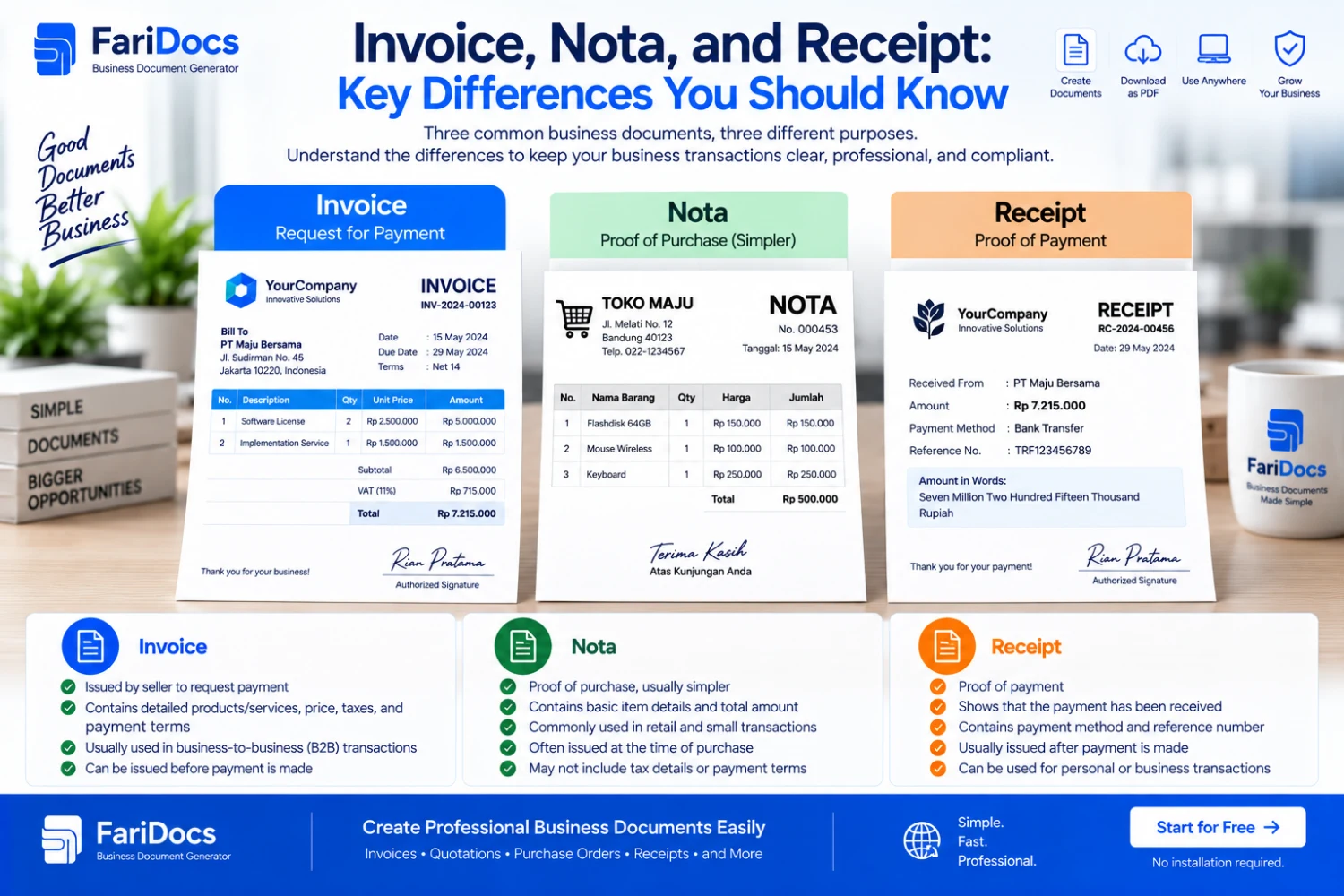
An invoice sets out a customer's bill, an Indonesian sales note or “nota” records the goods or services sold, and a payment receipt or “kwitansi” acknowledges money received. The document title alone does not establish whether a transaction is fully paid. Check its contents, payment status, and the amount actually received.
For example, a customer receives an invoice for IDR 3,000,000 and pays a deposit of IDR 1,000,000. The invoice records the bill, while the deposit receipt acknowledges the IDR 1,000,000 received. The outstanding balance is IDR 2,000,000.
Understanding these distinctions helps business owners, freelancers, sales administrators, and finance teams prepare the right documents. It also helps customers identify what they purchased, what they owe, and which payments have been acknowledged.
Invoice vs Nota vs Receipt: Comparison Table
AspectInvoiceSales note: notaPayment receipt: kwitansiMain focusCustomer billing detailsDetails of goods or services soldAcknowledgment of money receivedKey informationItems, prices, amount due, payment termsItems, quantities, prices, transaction totalPayer, amount received, date, payment purposeWhen it is usedWhen billing under the agreed termsWhen recording a saleAfter payment has been received and verifiedPayment statusMay be unpaid, partially paid, or paidMust be checked in the payment informationConfirms the amount received, which may be only a partial paymentExampleA design service invoiceA stationery store's sales noteA receipt for a design project depositHelpful referenceOrder or purchase order numberTransaction numberThe invoice being paidIn this article, nota means a sales note, rather than a credit note or debit note used to adjust a transaction.
What Is an Invoice?
An invoice is a document issued by a seller or service provider to detail a customer's bill. It typically includes the goods or services, quantities, prices, total, and payment instructions. The distinction between an invoice requesting payment and a receipt acknowledging payment is also explained in Midtrans's Indonesian guide to invoices and receipts.
Invoices are useful when customers need documentation to arrange payment, match a purchase order, or obtain internal approval. Freelancers and small businesses can use them as well as larger companies.
Useful invoice information includes:
Seller and customer names and contact details.
Invoice number and issue date.
Item descriptions, quantities, and prices.
Total amount and any applicable adjustments.
Agreed due date or payment terms.
Bank account details or other payment instructions.
Order or purchase order reference, where available.
Issuing an invoice does not itself establish that payment has arrived. If the customer has paid only part of the bill, record the amount received and the outstanding balance clearly.
What Does “Nota” Mean in Indonesian Business?
A nota penjualan is a sales record that usually lists goods or services, quantities, unit prices, and the transaction total. Stationery stores, building supply shops, and printing businesses commonly use this type of document.
The term is used differently across businesses. Some notas include confirmation that payment is complete; others mainly record the sale. Do not assume that every document titled nota confirms full payment.
To make a sales note easier to understand, include:
Business name and transaction date.
A sales note number for reference.
Items sold and total price.
Accurate payment information, such as paid or unpaid.
Customer details when needed for administration.
For instance, “10 notebooks, total IDR 100,000” describes a purchase. Adding “Paid by bank transfer on 10 September 2026” clarifies payment information once the seller has verified receipt of the funds.
For English-speaking customers, use a label that reflects the document's function. “Sales note” describes a sales record; “sales receipt” is more appropriate when the document also acknowledges payment. Avoid translating nota as “credit note” unless it actually records that type of adjustment.
What Is a Kwitansi or Payment Receipt?
A kwitansi acknowledges that a specified amount of money has been received for a stated purpose. It may record a service payment, deposit, or final settlement.
A useful receipt identifies the payer, amount received, date, payment purpose, and recipient. Including the invoice number connects the payment to the correct bill.
For clearer administration, add the payment method, amount in words where useful, and recipient authorization according to the business's procedures.
A receipt for a partial payment does not mean the entire invoice is settled. Label a deposit as a deposit and identify the relevant invoice. Use a final settlement description only after all required payments have been verified.
Example: Three Documents for One Business Transaction
The following fictional design project illustrates the differences. The amounts exclude taxes, discounts, and additional charges to keep the example simple.
1. An Invoice for the Design Services
Studio Kreasi receives an order from Toko Melati:
DescriptionQuantityUnit priceTotalVisual identity design1 packageIDR 2,000,000IDR 2,000,000Social media designs5 designsIDR 200,000IDR 1,000,000Invoice totalIDR 3,000,000Invoice INV-2026-0091 states the agreed deposit of IDR 1,000,000 and remaining payment of IDR 2,000,000 at the agreed project stage. Each payment deadline should be clearly communicated to the customer.
2. A Sales Note Recording the Services
If the business also uses sales notes, the nota can list the same services and reference INV-2026-0091. Its payment information should reflect the actual transaction status.
An additional sales note is not always necessary. Avoid producing duplicate documents without a clear administrative purpose, particularly when the customer might mistake one for a new bill.
3. A Receipt for the Deposit
After verifying that the deposit has arrived, Studio Kreasi prepares a receipt:
FieldExampleReceipt numberKWT-2026-0041Received fromToko MelatiAmount receivedIDR 1,000,000Amount in wordsOne million Indonesian rupiahPayment purposeDesign service deposit for invoice INV-2026-0091Date received10 September 2026Payment methodBank transferRecipientStudio KreasiThe remaining balance is IDR 3,000,000 − IDR 1,000,000 = IDR 2,000,000. When that balance is received, the subsequent payment is recorded separately against the same invoice.
Which Document Should Your Business Use?
Freelancers and Service Businesses
Use an invoice to bill for work or an agreed project milestone. After receiving payment, provide a receipt when needed to acknowledge it. Add a project name or service period to make matching payments easier.
Retail Stores and Small Businesses
A sales note can record everyday purchases. If a corporate customer requests an invoice, use the same transaction details and connect the references. Ensure that the invoice and sales note are not recorded as two separate sales.
Corporate Transactions
Before billing, confirm the customer's business name, billing address, PO reference, and finance email address. The customer may require supporting documents under its internal procedures.
When payment arrives, match the amount and reference to the invoice. If the amount received differs from the bill, clarify the reason before marking the invoice as fully paid.
Common Mistakes to Avoid
Treating an invoice as confirmation of funds received. Verify incoming payments before changing the payment status.
Confusing a deposit with full settlement. Record the amount received and remaining balance separately.
Using inconsistent customer names. Keep customer identities consistent across related documents.
Leaving invoice references off receipts. References are especially useful when a customer has several outstanding invoices.
Recording the same sale twice. Link documents that describe the same transaction.
Marking a bill paid based only on a transfer screenshot. Verify receipt against the business's payment records first.
Create Invoices and Payment Receipts with FariDocs
Use the FariDocs invoice generator to prepare a customer bill. After receiving payment, prepare the corresponding acknowledgment with FariDocs payment receipt.
Gather the transaction details, enter information appropriate to the document, and check the names and amounts before downloading the PDF. For a receipt, enter the amount actually received and reference the relevant invoice.
Choose filenames that are easy to identify, such as INV-2026-0091-Toko-Melati.pdf and KWT-2026-0041-Toko-Melati-Deposit.pdf. Consistent naming helps when customers request copies or finance teams match payments to bills.
Frequently Asked Questions
Is an invoice the same as a receipt?
They serve different purposes. An invoice details a bill; a receipt acknowledges money received. A receipt can reference an invoice to connect the payment to the bill.
Does an Indonesian nota always mean paid in full?
No. Check its payment information and the underlying payment records. A sales note without a payment status does not establish whether the whole amount has been paid.
Can an invoice be used for an immediate cash payment?
Yes. An invoice can detail a bill even if the customer pays immediately. The choice of document depends on the transaction and the customer's administrative needs.
Are receipts only for cash payments?
No. A receipt can acknowledge a bank transfer or another payment method. Record the method and receipt date accurately.
Does every sale need an invoice, a nota, and a receipt?
For transaction administration, choose documents according to the business process and customer requirements. An additional sales note that repeats an invoice may serve no practical purpose.
Does a paid invoice still need a separate receipt?
Check the customer's requirements. Some customers accept an invoice with complete payment information, while others request a separate receipt. Any paid status should be supported by verified payment records.
How should nota and kwitansi be translated into English?
Nota penjualan can be described as a sales note, or a sales receipt when it also confirms payment. Kwitansi is generally a receipt or payment receipt. Choose the term that accurately communicates the document's purpose.
Prepare your next invoice with FariDocs, then document payments received using a payment receipt when your business needs one.